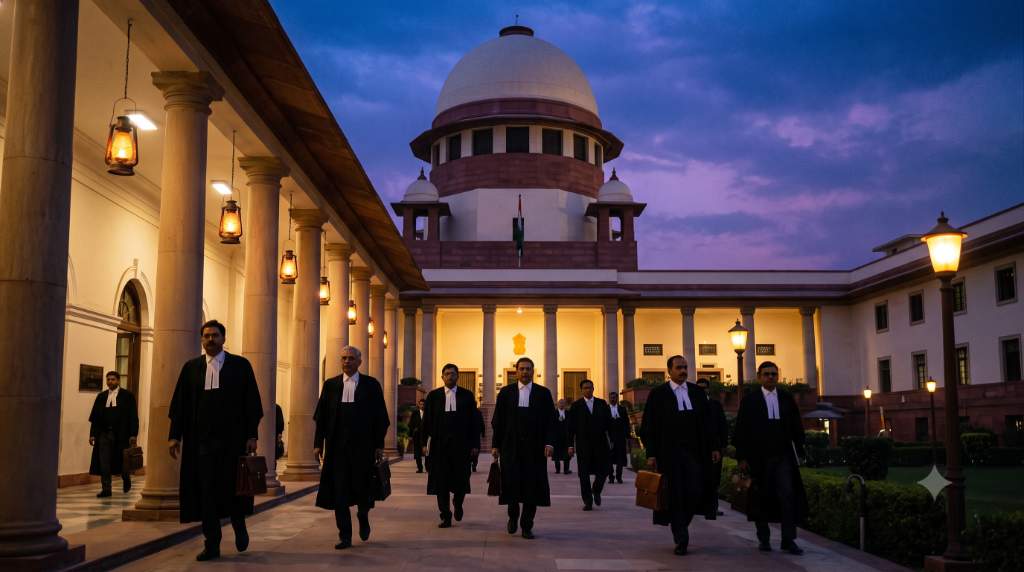
←LIBRARY|Mohd. Ahmed Khan v. Shah Bano Begum and Ors.
Still good law?Supreme Court of India · 1985
Mohd. Ahmed Khan v. Shah Bano Begum and Ors.
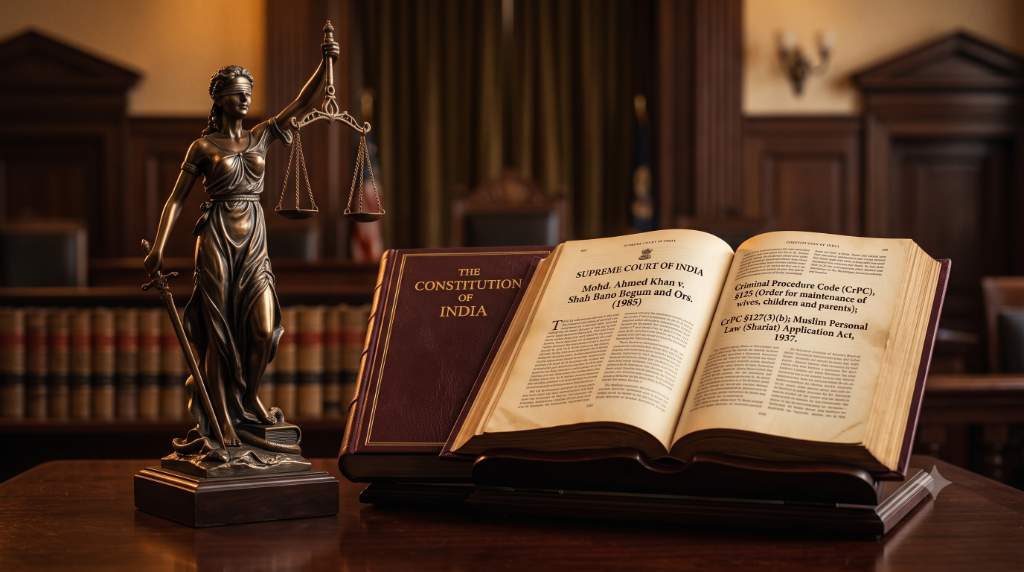
"Landmark trial on CrPC §125; CrPC §127(3)(b); Muslim Personal Law (Shariat) Application"
§Built from AIR 1985 SC 945
6 cited ¶Reviewed by Adv. Girish Kr. SrivastavaVerified
ILLUSTRATION
EPISODE 01 · THE PREMISE1 / 8
A Marriage of Forty Three Years Ended in a Magistrate's Court.
Mohd Ahmed Khan, an advocate by profession, married Shah Bano Begum in 1932. Three sons and two daughters were born of the marriage. In 1975, Khan drove Shah Bano out of the matrimonial home. In April 1978, she filed a petition before the Judicial Magistrate (First Class), Indore, under Section 125 of the Code of Criminal Procedure, asking for Rs. 500 a month in maintenance pointing to Khan's professional income, which she put at roughly Rs. 60,000 a year.
↳ What happened when Khan actually answered the petition?
Episode 1 of 8
EPISODE 02 · DRAMATIS PERSONAE2 / 8
The Matrimonial Rupture and the Legal Contenders.
DRAMATIS PERSONAE · KEY LITIGANTS & BENCH
3 PERSONAS
PERSONA 01
Shah Bano Begum
Primary Litigant
Aggrieved Party
The Petitioner Married to Mohd Ahmed Khan in 1932, mother of five (three sons, two daughters). Driven out of the matrimonial home in 1975. Filed for maintenance under Section 125 CrPC in April 1978.
PERSONA 02
Mohd. Ahmed Khan
The Respondent
Appellant
Appellant on appeal Advocate by profession, with a professional income alleged at roughly Rs. 60,000 a year. Paid Rs. 200/month for about two years before stopping. Pronounced an irrevocable talaq on 6 November 1978 after the petition was filed, and argued his liability was limited to the iddat period and the Rs. 3,000 Mahr he deposited.
PERSONA 03
Trial Court / Coram
Adjudicating Body
Court of Record
RECORD · VERIFIEDTHE STATESMAN · ARCHIVAL PRESS DISPATCH
Registry Dispatch · 1985
ARCHIVAL
SENSATIONAL TRIAL COMMENCES BEFORE SUPREME COURT OF INDIA
"Court inquiries commence regarding CrPC §125; CrPC §127(3)(b); Muslim Personal Law (Shariat) Application Act, 1937; Art. 44 Constitution of India. Public attention focuses on landmark hearing."
↳ How did the investigative authorities construct the record?
Episode 2 of 8
EPISODE 03 · THE DIVORCE, MID-CASE3 / 8
A Talaq Arrives While the Petition Is Still Pending.
While Shah Bano's maintenance petition was pending before the Magistrate, Khan divorced her by an irrevocable talaq on 6 November 1978. His defence shifted accordingly: the divorce, he argued, ended any obligation to maintain her; he had already paid Rs. 200 a month for about two years, and he had deposited Rs. 3,000 in court as dower (Mahr) for her iddat period. In August 1979, the Magistrate ordered him to pay just Rs. 25 a month. Shah Bano moved the Madhya Pradesh High Court in revision which, in July 1980, raised the amount to Rs. 179.20 a month. Khan appealed to the Supreme Court by special leave.
↳ Had the Supreme Court already settled this exact question before?
Episode 3 of 8
EPISODE 04 · THE REFERENCE TO A LARGER BENCH4 / 8
The Court Had Answered This Before. Now a Bench Wasn't Sure.
Two earlier three-judge decisions of the Supreme Court - Bai Tahira v. Ali Hussain Fidalli Chothia and Fazlunbi v. K. Khader Vali had already held that Section 125 applied to Muslims, and that a divorced Muslim wife could claim maintenance under it. But when Khan's appeal reached a Bench of Justices Murtaza Fazal Ali and A. Varadarajan, they doubted those rulings, holding that they might conflict with Section 127(3)(b) of the Code and with Section 2 of the Muslim Personal Law (Shariat) Application Act, 1937. On 3 February 1981, they referred the matter to a larger Bench of more than three judges.
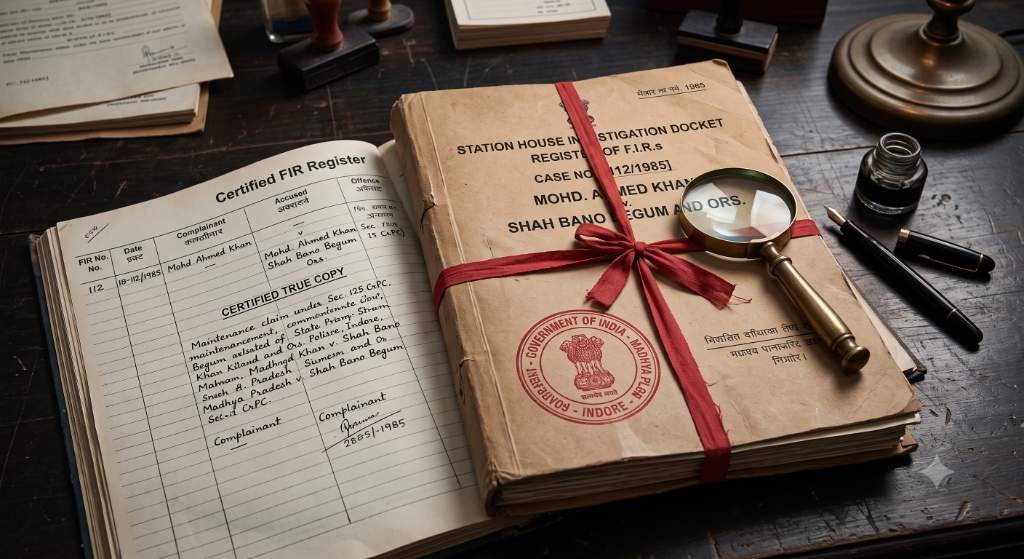
OFFICIAL POLICE RECORD
RECORD · VERIFIEDSTATION HOUSE CASE DIARY · OFFICIAL RECORD
DAILY DIARY ENTRY · CASE CRIME RECORD
Formal enquiry memo registered under CrPC §125; CrPC §127(3)(b); Muslim Personal Law (Shariat) Application Act, 1937; Art. 44 Constitution of India. Material exhibits seized and forwarded for judicial scrutiny.
↳ What arguments did each side actually make once the larger Bench convened?
Episode 4 of 8
EPISODE 05 · COURTROOM SHOWDOWN5 / 8
Section 125 CrPC vs. the Limits of Iddat.
Khan's argument: Under Muslim personal law, a husband's liability to maintain his divorced wife ends with the iddat period regardless of whether she can support herself afterward. Section 127(3)(b) required the maintenance order to be cancelled once the wife had received "the whole of the sum... payable on such divorce" under her personal law and Mahr, Khan argued, was exactly that sum.
Shah Bano's argument: Section 125 is a secular provision of the criminal code, not a codification of any single religion's law, and covers any wife "unable to maintain herself," regardless of faith. Mahr is not a sum payable "on divorce" at all it is payable in consideration of the marriage itself, merely falling due, in its deferred form, on the marriage's dissolution.
↳ How did the Bench work through these two positions?
Episode 5 of 8
EPISODE 06 · JUDICIAL DELIBERATION6 / 8
The Bench Weighs the Doctrine.
The Bench worked through the question methodically. It first tested whether a real conflict existed at all between Section 125 and Muslim personal law rather than assuming one and picking a winner. It examined the textbook authorities Khan relied on (Mulla, Tyabji, Paras Diwan), each stating that a divorced wife's maintenance right ends at iddat, and found them inadequate to answer the specific situation of a wife left unable to maintain herself at all. It then turned to Aiyats 241 and 242 of the Quran, in several published translations, and read them as themselves imposing an obligation on a Muslim husband to provide for a divorced wife. It rejected the All India Muslim Personal Law Board's submission - that an indigent divorced woman should look to relatives, "including nephews and cousins," for support - as "a most unreasonable view of law as well as of life."
FROM THE JUDGMENT · ¶8FROM THE CERTIFIED JUDGMENT
JUDICIAL DELIBERATION ON CrPC §125; CrPC §127(3)(b); Muslim Personal Law (Shariat) Application Act, 1937; Art. 44 Constitution of India
The court observed that statutory provisions must be interpreted in light of justice, equity, and good conscience.
Supreme Court of India Judicial Record
↳ What did the Bench actually decide, and on what terms?
Episode 6 of 8
EPISODE 07 · THE VERDICT7 / 8
The Appeal Fails. The Maintenance Stands.
ILLUSTRATION
YOU ARE THE JUDGE
Locked
How should the Supreme Court of India decide this issue under CrPC §125; CrPC §127(3)(b); Muslim Personal Law (Shariat) Application Act, 1937; Art. 44 Constitution of India?
Consider whether the statutory conditions of CrPC §125; CrPC §127(3)(b); Muslim Personal Law (Shariat) Application Act, 1937; Art. 44 Constitution of India were satisfied on the trial record.
Cast your decision above to unlock the court's actual ruling.
The five-judge Bench, led by Chief Justice Y.V. Chandrachud, dismissed Khan's appeal and confirmed the Madhya Pradesh High Court's order — directing him to pay Rs. 10,000 in costs to Shah Bano. The Court held that "wife" under Section 125's Explanation includes a divorced woman who has not remarried, with no religious qualification attached, and that a Muslim husband's obligation does not automatically end at iddat if his divorced wife remains unable to maintain herself. It further held that Mahr is not a sum "payable on divorce" under Section 127(3)(b), since it is paid in consideration of the marriage, not the divorce — so Khan's Rs. 3,000 deposit could not cancel the order. The Bench affirmed Bai Tahira and Fazlunbi as correctly decided, with one narrow correction on the Mahr/127(3)(b) point.
↳ What does this case actually stand for, going forward?
Episode 7 of 8
EPISODE 08 · RATIO & IMPACT8 / 8
SECTION 125 IS SECULAR. IT DOES NOT ASK YOUR RELIGION.
Section 125 CrPC is a provision of general, secular application that does not yield to personal law. A divorced Muslim wife unable to maintain herself is entitled to maintenance under it, even beyond the iddat period because Mahr is not a sum "payable on divorce" within Section 127(3)(b), and because Muslim personal law, on the Court's reading, does not contemplate leaving an indigent divorced wife without support at all. The Court also placed on record a separate observation not part of its operative holding regretting that Article 44 of the Constitution, the directive to secure a Uniform Civil Code, remained unimplemented, and urging the State to act on it.
Episode 8 of 8
IF THIS AFFECTS YOU
How this ruling protects your rights under CrPC §125; CrPC §127(3)(b); Muslim Personal Law (Shariat) Application Act, 1937; Art. 44 Constitution of India
✓Guarantees due process and statutory compliance under CrPC §125; CrPC §127(3)(b); Muslim Personal Law (Shariat) Application Act, 1937; Art. 44 Constitution of India.
✓Provides actionable grounds to challenge arbitrary state or private actions.
Supreme Court of India delivers landmark ruling defining CrPC §125; CrPC §127(3)(b); Muslim Personal Law (Shariat) Application Act, 1937; Art. 44 Constitution of India.
1995
Precedent affirmed and cited by subsequent constitutional benches.
EVERY TUESDAY
One landmark case in your inbox every Tuesday.
Join 14,000+ advocates, law students, and curious citizens reading certified Indian court stories.
SOURCES, CITATIONS & EDITORIAL REVIEW
Primary Law Report
AIR 1985 SC 945
Parallel: AIR 1985 Supreme Court of India 101 · (1985) 1 SCC 100